
What Is a Measure In Music? Bars, Beats And Counting
Jun 16, 2024
-
Tero Potila
When you're getting started with music theory, understanding structure is step one. The measure forms the core of this foundation, giving us a clear way to turn raw rhythm and beats into readable notation.
I get how looking at sheet music for the first time can feel like you’re trying to read ancient hieroglyphs. But once you crack the basic code, it all makes perfect sense.
A measure is a small container of time that lets you organize rhythm and beats and describe how they relate to time signatures.
Once you understand these concepts, you can use them to write better songs in your DAW (Digital Audio Workstation).
What Is a Measure in Music?
At its core, a measure in music (also known as a bar) is a small segment of musical time defined by a given number of beats.
It holds a fixed amount of rhythmic value, no matter what notes it contains.
Think of it as a small container of time.
The size of that container never changes within a specific section of a song, but what you put inside it can look completely different from one measure to the next.
One measure might hold a single, long sustained note, while the next might hold a flurry of short, quick sixteenth notes.
As long as the mathematical values add up to the limit set by the time signature, the measure is complete.
Here’s an interesting historical fact: It’s believed the first measures were added to written music in Europe around the 15th century to help musicians stay organized.
Bar vs. Measure: Is There a Difference?
I’m sure you’ve heard musicians use the word “bar” instead of “measure.”
Don’t let this trip you up; both terms point to the exact same segment of time on the staff, and both are correct.
Generally, British English speakers say “bar,” while American English speakers more often say “measure.”
In my experience, “bar” shows up more in casual studio conversations, lead sheets, and guitar tabs, while “measure” appears more often in formal music theory and classical instruction.
So, if someone says, “let’s start from bar 16,” they’re pointing to the exact same spot as measure 16.
Breaking Down Barlines
A measure is bounded by vertical lines drawn straight through the staff. These are called barlines.
If you picture sheet music with no barlines at all, it would be just a long, unbroken string of notes. Reading that would get exhausting very quickly.
Barlines give both your eye and your counting a place to reset.
There are a few different types of barlines you’ll encounter:
Single Barlines

The standard vertical line marking the end of one measure and the start of the next.
Double Barlines

Two vertical lines placed close together. These denote a structural change, such as the end of a specific section (like moving from a verse to a chorus) or a significant phrase, but not the end of the song.
End Barlines

A double barline where the second line is thick and bolded. This means you’ve reached the end of the piece.
Repeat Signs

These feature two vertical lines with two dots. A start repeat (dots on the right) marks the beginning of a section, while an end repeat (dots on the left) tells you to loop back.
If there is no start repeat, you go back to the very beginning of the piece.
Dashed Barlines
Less common, but used by composers to divide measures in complex time signatures to make tricky rhythms easier to read.
How Time Signatures Set the Beat Count
We really can’t talk about measures without time signatures.
The time signature sits at the beginning of the staff as two stacked numbers. It determines exactly how long each measure is:
- Top number: Tells you the specific number of beats that fit into each measure.
- Bottom number: Tells you the type of note that receives one beat (2 = half note, 4 = quarter note, 8 = eighth note).
For example, in 4/4 time (often called Common Time), the top 4 means there are four beats per measure, and the bottom 4 means the quarter note gets the beat.
Once you know both numbers, you know the exact amount of rhythmic value every single measure has available.
What Is the Math Behind Time Signature Denominators?
The denominator (bottom number) in a time signature is always a power of 2.
Here’s the math behind this: Note values double or halve as you subdivide them.
That means the denominator doubles every time, resulting in powers of 2.
There are some irrational time signatures like x/6 or x/12 you might come across in modern music, but outside of that, signatures always use powers of 2.
Simple vs. Compound Meter
Meters generally fall within two categories:
- Simple Meter: Beats can be divided evenly into two. 4/4 is a simple meter. You can hear this straightforward pulse in songs like “Stronger” by Kanye West or Sabrina Carpenter’s “Espresso.”
- Compound Meter: Beats are felt in groupings of three. 6/8 is a classic compound meter. While it technically holds six eighth notes, performers usually feel it as two larger beats, each divided into three (ONE-two-three, TWO-two-three). Think of the waltzing, swaying feel of Queen’s “We Are the Champions” or Taylor Swift’s “Dear John.”
Note Values in a 4/4 Measure
A note’s value describes how long it lasts.
Here’s a simple way to picture how different note combinations fill the same 4/4 measure “budget”:
| Note Value | Beats It Fills | Notes Needed to Fill One 4/4 Measure |
| Whole note | 4 beats | 1 |
| Half note | 2 beats | 2 |
| Quarter note | 1 beat | 4 |
| Eighth note | 1/2 beat | 8 |
| Sixteenth note | 1/4 beat | 16 |

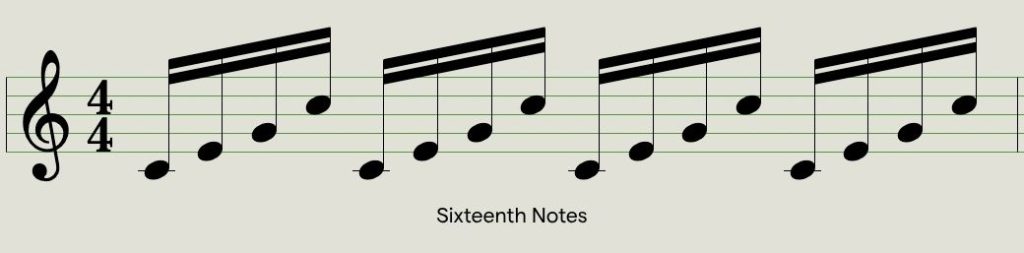
The number of notes in a bar can change dramatically, but the total rhythmic value never does.
How to Count Measures Like a Pro
If you want to play with other musicians or record tight takes in your DAW, you have to know how to count.
Nobody makes it into a professional gig without counting!
When learning a new piece, first identify the downbeat (beat 1, the strongest beat in the measure) and the upbeats (the off-beats between main beats).
Start by counting out loud using the smallest active subdivision.
If you are in 4/4 time with eighth notes, count: “1 and 2 and 3 and 4 and” (where numbers represent downbeats/main beats, and “and” represents upbeats).
As you get more comfortable, zoom out to count just the main beats: “1, 2, 3, 4.”
The same goes for other meters:
- 3/4 time: Count “1, 2, 3.” Each measure holds three quarter-note beats, giving the music a waltz-like lilt.
- 2/4 time: Count “1, 2.” Two quarter-note beats per measure create a brisk, marching feel.
Sometimes composers shift the beat pattern partway through a piece, or use complex, asymmetrical time signatures like 7/8 or 5/4, especially popular in jazz and prog rock.
Once you can count a straightforward 4/4 bar with confidence, tackling these irregular signatures becomes just a matter of practice.
What Is the Difference Between Time Signature And Meter?
Time signature is the written symbol on the page. Meter is the actual feel and pulse of the music.
My Pro Tip: Understanding the meter of music is crucial so you can count and feel even the more unique time signatures.
I already mentioned this with the 6/8 signature. To me, the same approach works for, say, 7/8; it often feels like a group of 3 and a group of 4 (ONE-two-three, TWO-two-three-four) counted one after the other.
Once you internalize this, it becomes easy to understand and follow the beat of the piece.
Measures and Song Structure
Measures are the ultimate building blocks for song structure.
In Western popular music, phrases almost always show up in balanced sets of 4 or 8 measures.
When I’m setting up a new song project in my DAW, I like to visualize the arrangement as a blank score built in groups of measures.
It makes songwriting significantly less daunting.
A typical pop song structure layout might look something like this:
- Intro: 4 bars
- Verse 1: 8 bars
- Pre-Chorus: 8 bars
- Chorus: 8 bars
- Verse 2: 8 bars
- Bridge: 8 bars
- Double Chorus: 16 bars
Sectioning out content into measures like this helps you see exactly how long your musical ideas need to be, and where you need transitions or drum fills.
It also gives allotted space for improvisation.
In jazz, musicians frequently “trade 4s,” a call-and-response style born in New Orleans where soloists take turns improvising over 4-bar sections.
Incomplete Measures and Breaking the Rules
Just as we learned the rules and it all began to make sense…
Sometimes, a measure doesn’t follow the rules.
An incomplete measure holds fewer beats than the time signature calls for.
The most common example is a pickup note (also known as an anacrusis). This is a note or short phrase that leads into the first full measure of a song.
Think of the word “Hey” in The Beatles’ “Hey Jude”; it sits as a pickup note on beat 4 in an incomplete measure before the first full bar lands on “Jude.”
Mathematically, any beats borrowed by a pickup measure are subtracted from the final measure of the piece to keep the overall song balanced.
Some pieces have no measures at all.
In avant-garde music, medieval plainchant, Renaissance polyphony, or French Baroque préludes non mesurés (unmeasured preludes), strict measures were omitted to give the music a free-flowing, unmetered feel.
Modern composers like John Cage or Catherine Lamb also frequently wrote pieces without strict barlines to create loose, floating rhythms.
How to Use Measures in Your DAW
Even if you’re not planning on reading traditional sheet music, understanding measures is vital for modern music production.
When you open a project in a modern DAW like Soundtrap Studio, the grid at the top of your workspace is divided into measures and beats. Those vertical grid lines are your barlines.
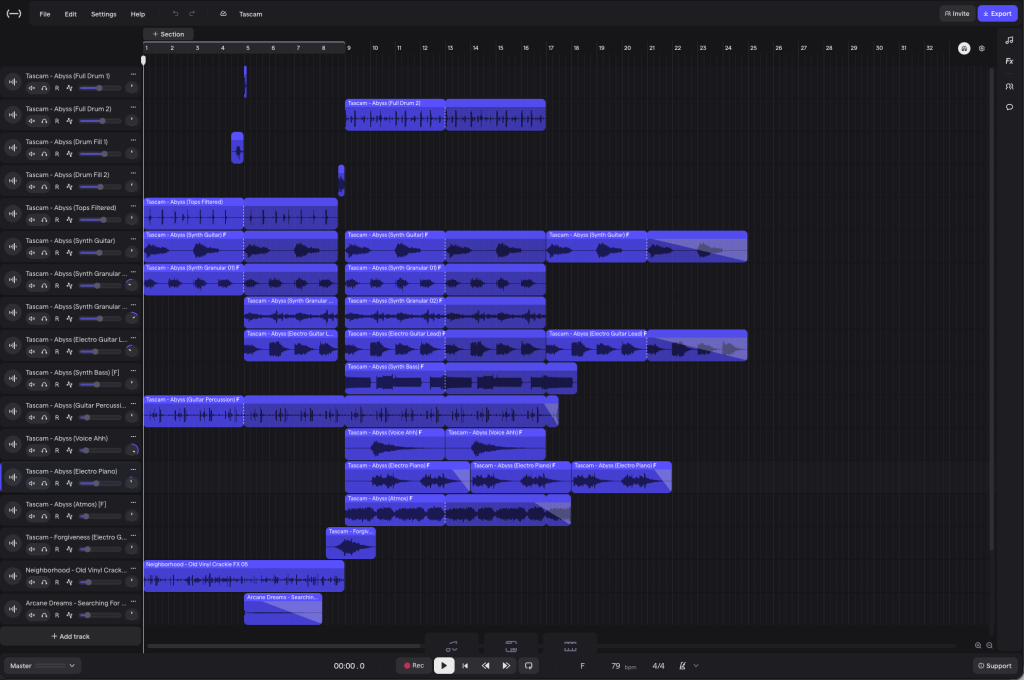
My Pro Production Tip: When sketching out your own song, try snapping your loops and MIDI regions into 4-bar or 8-bar blocks.
Notice where a musical phrase naturally wants to breathe or resolve, and use that 4th or 8th bar boundary to introduce a new element, like a crash cymbal or a chord change.
Now, I’m not suggesting all music should be built out of rigid blocks that always begin and end strictly following this structure like a robot.
These blocks give you a solid structure to start from. But when you feel like the section you’re working on needs to break out of a structure like this, follow your gut.
If it sounds right, it is right!
When to Introduce Irregular Signatures
Here’s a simple example of a situation where I often use a slightly longer bar at the end of a block:
Imagine the song is coming to the end of the second verse, about to enter the second chorus.
Sometimes, the feeling of an extra ‘hold’ right before the second chorus provides an added level of anticipation and energy.
So if my song is in 4/4 time, I might use a 5/4 bar at the end of the 8-bar block that forms the second verse.
Once the second chorus finally kicks in one extra beat later, the emotional impact helps it hit just a little bit harder.
Conclusion
A measure is the basic container of rhythm, keeping everyone on stage, and everything in your DAW, perfectly locked in time.
Once counting through common time signatures like 4/4 and 6/8 feels natural, reading sheet music stops feeling overwhelming.
The same bar lines that once looked like arbitrary marks become the reference points you’ll use to rehearse, arrange, and produce.
The best way to get really good with the concept of measures in music is to put everything we covered into practice.
Open up a new project in your DAW, lay out a 4-bar loop, and start building your own beats today!
About the author
Tero Potila is a professional music composer and producer. His career combining knowledge and experience from music, TV, film, ad, and game industries gives him a unique perspective that he shares through posts on teropotila.com.


