
Guide: How To Process Synths & Fit Them In Your Mix
Feb 23, 2026
-
Tero Potila
Learning how to process synths so that they can cut through your mix is essential for defining your sound and taking your productions to the next level.
From subtle compression and EQ to creative effects chains, understanding how to shape your electronic instrument sounds is a foundational skill in music production.
This applies to both hardware synthesizers and software instruments; the right processing techniques make the difference between amateur and professional productions.
The key to processing synths effectively is knowing when to enhance the source sound and when to transform it completely through creative effects.
I’m sure you’ve struggled with a synth that sounds great in isolation but disappears in a full mix, or over-processed unique sounds only to find they lost their character.
Getting this balance right comes down to understanding both technical fundamentals and creative possibilities.
The best approach combines getting sounds right at the source with strategic processing that serves the music.
How to Process Synths
Understanding how synthesizers generate sound is essential before you can effectively process them.
The synthesis method, waveform characteristics, and modulation capabilities all determine how your processing chain will shape the final sound.
Types of Synthesizers
Analog

The Moog Sub Phatty is a great example of an analog monosynth.
Analog synthesizers use electrical circuits and voltage control to generate sound.
These instruments create audio through analog circuits that produce continuous electrical signals, giving them their characteristic warmth and harmonic richness.
I mostly use software synths nowadays, but whenever I can get my hands on analog synths, it definitely ends up in the mix! There’s something to be said for having real, physical controls, and the psychological effect of using the original analog synth.
Virtual instrument versions sound practically indistinguishable from the originals, but using the real thing just feels incredible.
Digital
Digital synthesizers generate sound through digital signal processing and mathematical algorithms.
Software synthesizers fall into this category, offering unlimited polyphony and precise recall of settings.
You’ll find they excel at complex modulation and can replicate various synthesis methods within a single instrument.
Hybrid
Modern synths often combine both approaches in hybrid designs.
These instruments use analog circuits for certain components, such as filters and oscillators, while relying on digital processing for modulation and effects.
Basic Waveforms and Sound Sources
Every synth sound starts with a raw waveform from an oscillator:
- The sine wave contains only the fundamental frequency with no harmonics, producing the purest tone.
- A square wave contains only odd harmonics, resulting in a hollow, woody, or reed-like quality. Because of its ‘buzzy’ nature, it’s a staple for everything from retro chiptune leads to thick, hollowed-out bass patches.
- The sawtooth wave is the richest basic waveform, containing all harmonics in descending amplitude. This makes it ideal for cutting leads and bass sounds that need presence in a mix.
Different synthesis methods shape these basic waveforms in distinct ways:
- Subtractive synthesis filters harmonics from complex waveforms.
- Additive synthesis builds sounds by combining multiple sine waves.
- Frequency modulation creates harmonics by modulating one oscillator with another.
- Wavetable synthesis scans through stored digital waveforms
- Granular synthesis manipulates tiny sound fragments.
Oscillators, Envelopes, and Modulation Essentials
Oscillators generate the initial sound, but envelopes and modulation bring them to life.
The amp envelope controls volume over time through four stages: attack, decay, sustain, and release.
Filter envelopes work identically but control brightness instead.
Understanding the behavior of a low-frequency oscillator (LFO) is crucial before adding external processing.
An LFO creates rhythmic movement below audible frequencies, modulating parameters like pitch, filter cutoff, or amplitude.
When you see an LFO tool creating pumping effects, it’s applying this principle through volume/amplitude modulation.
I recommend first starting with preset sounds, as this can help you understand the fundamentals faster than building from scratch.
Analyze how each parameter affects the raw waveform. Twist the filter cutoff, adjust envelope times, and change LFO rates to hear their impact.
Don’t be afraid to push each parameter to its extremes to learn how it affects the sound.
This hands-on approach to sound design reveals which synth characteristics you’ll need to enhance or tame during processing.
Creative Processing Techniques for Synths
Now that you have synth sound design down, the next step is processing the sound.
The goal is to transform basic synth sounds into polished, professional elements that sit perfectly in your mix.
The right combination of filtering, modulation, and effects can turn a simple pad sound into a lush, evolving texture that fills your stereo space with character.
Filtering and Shaping Frequency Content
EQ filters shape frequency content to carve out space in your mix and enhance tonal character.
A low-pass filter removes high frequencies above a cutoff point, smoothing harsh tones and adding warmth to bass lines and pads, and a high-pass filter cuts low frequencies, preventing muddy buildup when processing synth bass or lead elements.
Resonance at the filter cutoff point adds emphasis to frequency-specific areas of your sound.
Try pushing the resonance on a filter to create acidic, aggressive textures that cut through busier patterns.
You can also automate filter sweeps to add movement and additional groove to static sounds.
Personally, I like to apply different filters to various frequency bands to create complex sound textures.
Try using a multiband filter to process only the high end with modulation while leaving the low end stable. This approach works especially well for lush pads in ambient music.
Here are some key filter applications that typically work well for synths:
- Bass synths & kick drum: Apply a high-pass filter to one of them at 30-40 Hz to remove sub-bass frequencies that could clash with a subby kick drum or bass.
- Leads: Low-pass filter sweep for dramatic builds and transitions
- Pads: Gentle filtering to reduce harsh high frequencies without losing air
One important note on bass synths: decide whether the bass or the kick drum should own the sub-bass territory.
To prevent frequency masking, apply a high-pass (low-cut) filter to the element you want to sit ‘above’ the others.
For example, if your kick is the heartbeat of the track, high-passing your synth bass at 40Hz-80Hz will give the kick the room it needs to breathe.
There’s no real rule for which way to go; If I’m not sure, I listen to the track both ways and usually one sounds better than the other.
Sometimes the track just works better with a deep sub-bass kick, sometimes a snappier kick with a deep bass gives it the right energy.
Compression
Just like any other mix element, sometimes compression is the right tool for adding definition and energy to the synth sound.
While synths often have consistent dynamics due to their internal envelopes, compression is vital for “gluing” a patch together or emphasizing the “pluck” of a lead.
By using a slower attack time, you can let the initial transient pop through before the compressor clamps down, giving your synths a more percussive, aggressive edge that commands attention in a dense arrangement.
Layering, Modulation, and Stereo Enhancement
Layering multiple synths is another trick I apply often. It helps with creating richer, more complex sounds than a single oscillator can produce.
Combine different waveforms from separate synth instances, then pan them slightly apart to fill your stereo space.
A mono bass layer with a wide pad layer gives you both focus and width.
Modulation adds movement and life to static sounds. It can bring a boring sound alive.
LFOs modulating filter cutoff, pitch, or amplitude create evolving textures that hold the listener’s attention.
Try setting different LFO rates on layered synths to generate polyrhythmic movement.
The side-chain technique is another great trick that you can use to sync your synth with other elements.
A bass sidechained to your kick drum can create space and add additional groove. You can also side-chain pads to vocal phrases for dynamic interaction between elements.
There are also some great stereo enhancement effects that can really bring your mix alive:
- Chorus can help add natural width to leads and pads.
- Delay panning brings stereo movement to otherwise dull mono synths.
- Try applying the Haas effect to add perceived width to layered sounds, but monitor your mono compatibility closely; if pushed too far, you risk destroying the mix with comb filtering and phase issues.
Try also processing each layer differently to maximize separation. One layer might work well with heavy saturation while another stays clean, creating depth through contrast.
Using Effects for Depth and Character
Effects can help transform your synths into unique sounds that stand out in the mix.
Saturation
Saturation plugins are great for additional harmonics that fatten thin sounds and create presence. Drive the input harder for aggressive distortion or apply subtle warmth to glue elements together.
Reverb
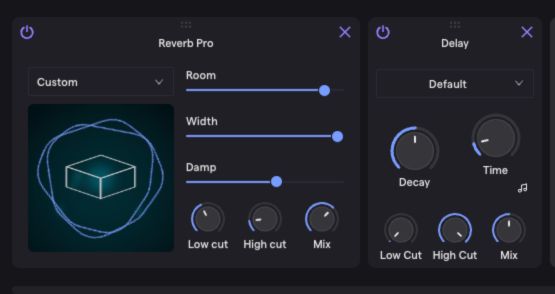
Reverb Pro and Delay effects from Soundtrap.
Reverb is one of the most important effects in your arsenal; it gives you the ability to place instruments in acoustic spaces ranging from tight rooms to vast halls.
Short reverbs keep elements upfront in busier patterns, while long, metallic reverbs create atmospheric beds for ambient music.
Pro tip: Keep reverb at manageable levels on bass-heavy sounds to avoid muddying the low end.
Delay
Delay adds rhythmic interest and fills gaps in your arrangement.
For example, you can use a dotted-eighth note delay to create movement between main rhythm divisions.
You can also filter the delayed signal differently from the dry sound to prevent it from clouding your mix.
Parallel Processing
Parallel processing is another great way to add heavy-handed processing when a synth needs it, and I use it all the time; it lets you blend the processed signal with the clean sound, maintaining clarity while also adding the heavy processing character.
Experiment with various ways to route effects, and don’t be afraid to push things too far. That’s a great way to learn how each effect works and how it fits in within your mix.
Processing Synths Directly in Soundtrap
You don’t need a rack of hardware to achieve professional results; Soundtrap’s built-in effects offer a streamlined way to apply these techniques.
For essential frequency shaping, open the Visual EQ on your synth track. It’s the easiest way to visually identify muddy frequencies and roll them off using a high-pass filter.
To add character, explore the Effects menu and experiment with the Juicy Distortion or Overdrive; these are perfect for giving digital synths some analog grit.
If you want that signature EDM “pump,” apply the Instant Sidechain effect. With presets like “Medium Duck,” you can make your synth pulse perfectly to the beat without the hassle of complex routing.
By stacking these effects in your track’s signal chain, you can move from a raw preset to a polished, custom sound in just a few clicks.
Conclusion
Mastering how to process synths is something you’ll learn through constant experimentation. Sometimes your track might need a gently sculpted sub-bass to sit under a kick, or use aggressive parallel saturation to make a lead scream.
The goal still remains the same: serving the emotion of the track.
When I was getting started in music production, I often got way too caught up in the “rules”. It is important to learn the rules, but remember that in the end, it all comes down to trusting your ears and your taste.
If a heavily processed, phase-shifted, distorted mess sounds right for your song, then it is right.
The more you play with these tools, the more you’ll develop an intuitive sense of what a sound needs to truly come alive in the mix.
Frequently Asked Questions
Should I process my synths in mono or stereo?
It depends on the synth’s role; Generally, bass synths and sub-layers should stay in mono to ensure a solid low-end foundation. For leads and pads, stereo processing helps create width and depth, but always check your mono compatibility to ensure the sound doesn’t disappear on smaller speakers.
Why does my synth sound great alone but gets lost in the mix?
This is usually due to frequency masking. When multiple instruments compete for the same frequency range, they cancel each other out. Use a high-pass filter to remove unnecessary low-end from your synths, carving out a specific “pocket” for the sound to live in.
Do I need to compress every synth patch?
Not necessarily. Many synth sounds are already quite compressed due to their internal envelopes. Use compression only when you need to “glue” a sound together, control stray peaks, or use a slow attack time to emphasize the “pluck” and transient of a lead sound.
What is the best way to make a synth sound more “analog”?
To add analog warmth to a digital or software synth, use saturation or subtle distortion to introduce harmonic overtones. You can also slightly modulate the pitch or filter cutoff with an LFO to mimic the “drift” and instability of vintage electrical circuits.
How do I make my synth leads cut through a dense mix?
The most effective way is to use a sawtooth waveform, which is rich in harmonics, and apply a boost in the upper-mid frequencies (around 2kHz–5kHz). Adding a bit of saturation and using a subtle delay instead of a heavy reverb will also keep the lead upfront without washing it out.
About the author
Tero Potila is a professional music composer and producer. His career combining knowledge and experience from music, TV, film, ad, and game industries gives him a unique perspective that he shares through posts on teropotila.com.


